
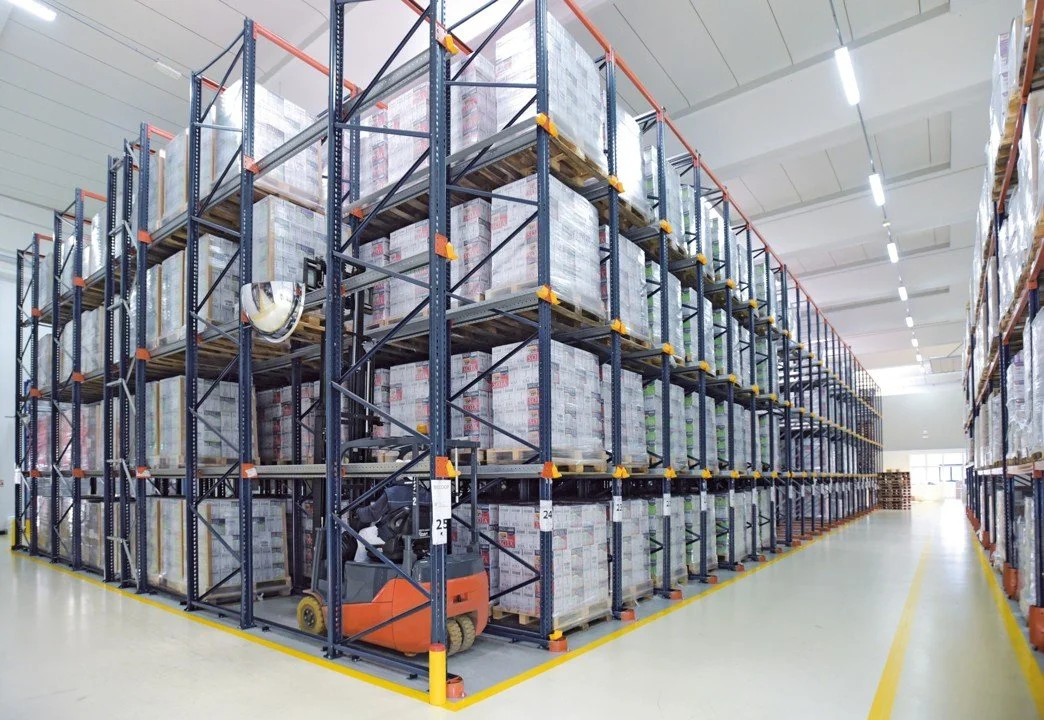
Drive-In / Drive-Through Racking
High-Density Storage — Fewer Aisles, Deeper Lanes
A high-density storage solution that reduces aisle requirements through deeper pallet lanes. Drive-In systems use LIFO (Last-In, First-Out) for bulk homogeneous products, while Drive-Through configurations support FIFO access from both ends. These layouts are worth evaluating for cold storage and distribution operations holding large quantities of similar products.
- High-density lane storage with capacity based on your layout
- LIFO system (Last-In, First-Out) for Drive-In configurations
- FIFO system available with Drive-Through configurations
- Ideal for bulk or non-perishable storage
- Significantly fewer aisles required vs. selective racking
- Deep lane storage for multiple pallets per lane
- Reduces total square footage required for storage
Drive-in vs. drive-through pallet storage
High-density racking groups pallets in deep lanes rather than providing an aisle for every rack row. This can suit warehouses holding large quantities of similar products, but it changes how operators access inventory. Evaluate lane depth, pallets per SKU, stock rotation, and handling procedures together. A denser layout is only useful if it also supports the way your warehouse receives, stores, and dispatches products.
Drive-in: access from one end
Drive-in configurations use the same end of a lane for loading and retrieval. This supports last-in, first-out (LIFO) handling: the most recently placed pallet is generally the first available for removal. It can suit bulk storage where that access pattern matches the product's rotation requirements.
Drive-through: access from both ends
Drive-through configurations provide access at opposite ends of the storage lane, supporting first-in, first-out (FIFO) handling when loading and retrieval are organized accordingly. The facility layout must provide appropriate access on both sides. FIFO performance depends on the operating process as well as the rack arrangement.
Density versus individual pallet access
Fewer aisles and deeper lanes can increase storage density, but they do not give the same direct access as selective pallet rack. Compare the number of pallets held per SKU and the frequency of retrieval. The actual capacity gain depends on the building, lane configuration, pallet dimensions, and equipment—not a universal percentage.
Information for a high-density racking quote
- Number of SKUs and pallets typically held per SKU
- Required stock rotation: LIFO, FIFO, or direct pallet access
- Pallet dimensions, loaded heights, and maximum weights
- Available floor area and access at one or both ends
- Handling equipment and the current receiving and dispatch process
Frequently asked questions
When is drive-in racking a good option?
It is worth evaluating for large quantities of homogeneous products when LIFO access fits the operation. Facilities needing frequent access to many different individual pallets should also compare selective pallet racking.
Does drive-through automatically guarantee FIFO?
Access from both ends supports FIFO handling, but stock rotation also depends on how pallets are loaded and retrieved. The layout and warehouse procedures need to be planned together.
How much space will a high-density system save?
There is no single saving that applies to every facility. Pro Space Racking can review your layout, product profile, and proposed lane depths to compare storage arrangements for your project.